
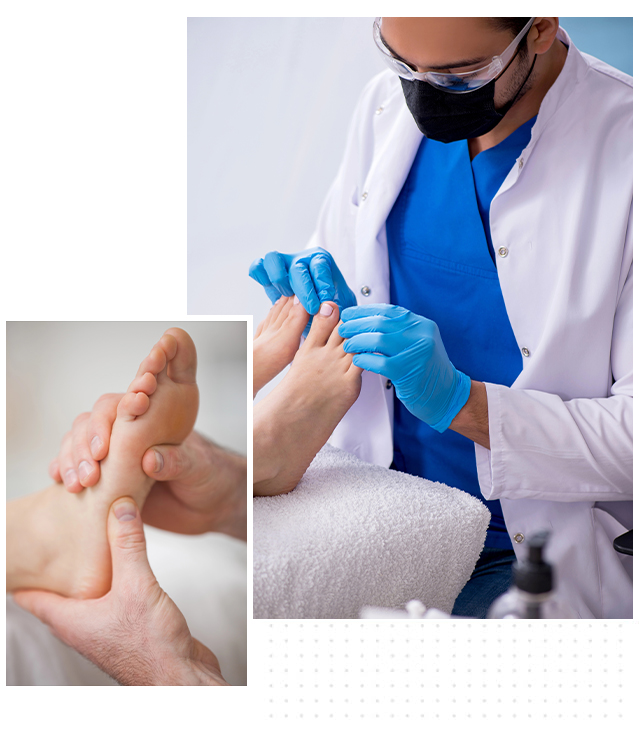
OUR FOOT CLINIC
MEET DR. HAROUNIAN
Dr. Harounian graduated from UCLA with a bachelor of science degree in human physiology in 1996. He then attended New York college of podiatric medicine with academic scholarship and maintained his place in the Dean’s list throughout the entire time. Dr. Harounian graduated in June of 2000 with certification of achievement in principles of osteology, immunology, neuroscience and genetics.

Our Podiatrist Services
At LA Foot Laser, we’re dedicated to delivering innovative and personalized podiatrist services. Our expert team is equipped to offer a full spectrum of care, from comprehensive diagnosis to advanced treatment options for an extensive range of foot and ankle disorders.
Leveraging cutting-edge surgical techniques, state-of-the-art treatments, and the potential of regenerative medicine, we’re committed to facilitating your journey to optimal health and recovery.
Our services encompass everything from chronic pain management and sports injury prevention to effective therapies. We address common concerns like ingrown toenails and toenail fungus with precision and care. Additionally, we provide custom orthotic solutions tailored to enhance your mobility and overall quality of life significantly.
For conditions that qualify, we also offer laser treatments, ensuring swift relief and minimal downtime. Our approach is always patient-centered, aiming to exceed your expectations and improve your health outcomes.
See What Our Patients Are Saying


 | James Z.
One of the best podiatrists I have come across. He is charismatic, makes you feel at home, no question is too stupid or ridiculous. Not only does he assure you that he cares, but you can feel that genuine sentiment. I first visited Dr. Harounian
| Kamran H.
What truly inspired me to drop these lines here is not just to help Dr. Harounian to get better reviews for his practice.I am writing this for all of those who are seriously in need of a good and caring, foot doctor and don’t know where to start
| Amy G.
I found Dr. H. because of the rave reviews on platforms like this one, and I can attest to their truth. I spent YEARS having other doctors treat one of my toenails. Dr. H. was thorough and honest about the probability of curing the infection, and discussed options from cost to invasiveness. He shows great empathy for his patients and is ALWAYS timely, which is a big deal in my opinion. After laser treatments and eventually surgery, Dr. H. cured my nail’s infection. I truly never thought I’d see the day!
| Tania C.
I had an emergency and was so shy to show my feet , I didn’t want to go anywhere ! Eventually I found Dr. Kourosh on Yelp & read the reviews, people seemed like they loved him . I went and was so glad I chose him he & his staff makes you feel welcomed . He really cares about you & does everything possible to help ! Will definitely come again!
| Stanley W.
Great Podiatrist Doctor. Tried to help me and didn’t force himself on me with a consult and actually told me to try to get service through my insurance and referred to someone else…We need more physicians with this kind of care for people vs just making money. I appreciate his compassion and honesty in dealing with me vs brushing me off as he was not going to profit giving me advice. Thank you.
| Ck C.
Absolutely wonderful doctor!!! Very nice and helpful!!! He truly cares!!!!! He is friendly, knowledgeable and has a great staff. I just called his office with a question about a medication I have to take & the receptionist transferred my car to him and he answered!!! AMAZING!!! My former primary care doctor of 18+ years NEVER too a phone call from me!!!! This man is a great podiatrist doctor & good person!! Keep it up!!
| Clarissa J.
Best doctor I have been to! They fit you in I live in Vegas and drive all the way over there to see him.