

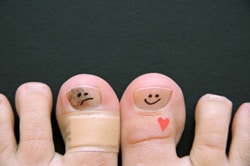
 Toenail fungal infection is one of the most prevalent infections seen in the United States today and some people are more hereditary suseptible in having it.
fungus usually grows in dark, moist areas and can invade the body through minor cuts, or after injury or irritation in which the toenail becomes separated from the bed. The fungus can cause the nail to thicken and become discolored, often yellow or brown. A foul-smelling debris can accumulate under the nail leading to pressure and pain. After confirming the presence of toenail fungus infection , It is best to treat the infection in early stages when the nail starts to thicken or becomes discolored.
In the past it used to be that in the early stages, an oral medication was given which had some series side effects in the body especailly on the liver if taken for too long. In case a patient was unable to take the oral medication or the infection was to advanced, the infected nail was surgically removed by administering local anesthesia in the office.
Now however, Dr. Harounian has incorporated the newest and the most effective pinpointe laser machine in to his practice to get ride of all the fungal infection with no pain and no known side effects in only 30 minutes. The procedure is quick and easy and entails lasering all 10 toes regardless of how many are infected, to minimize the risk of reinfection.
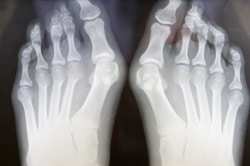 Bunions are misaligned big toe joints that can become swollen and tender, causing the first joint of the big toe to slant outward, and the second joint to angle toward the other toes. Bunions tend to be hereditary, but can be aggravated by shoes that are too narrow in the forefoot and toe. Surgery by a podiatric physician is frequently recommended to correct the problem.
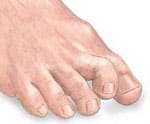 Hammertoe is a structural deformity in which abnormal biomechanics cause the toe(s) to contract at one, two or all three of the joint within that toe. Normally Hammertoes by themselves are not painful, but by wearing shoes,as the prominent knuckle of the toe rubs against the shoe, it becomes irritated and can lead to what is called a corn
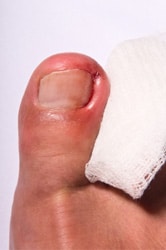 Ingrown Toenails which are often painful are usually the result of trimming your toenails too short, particularly on the sides of your big toes.